
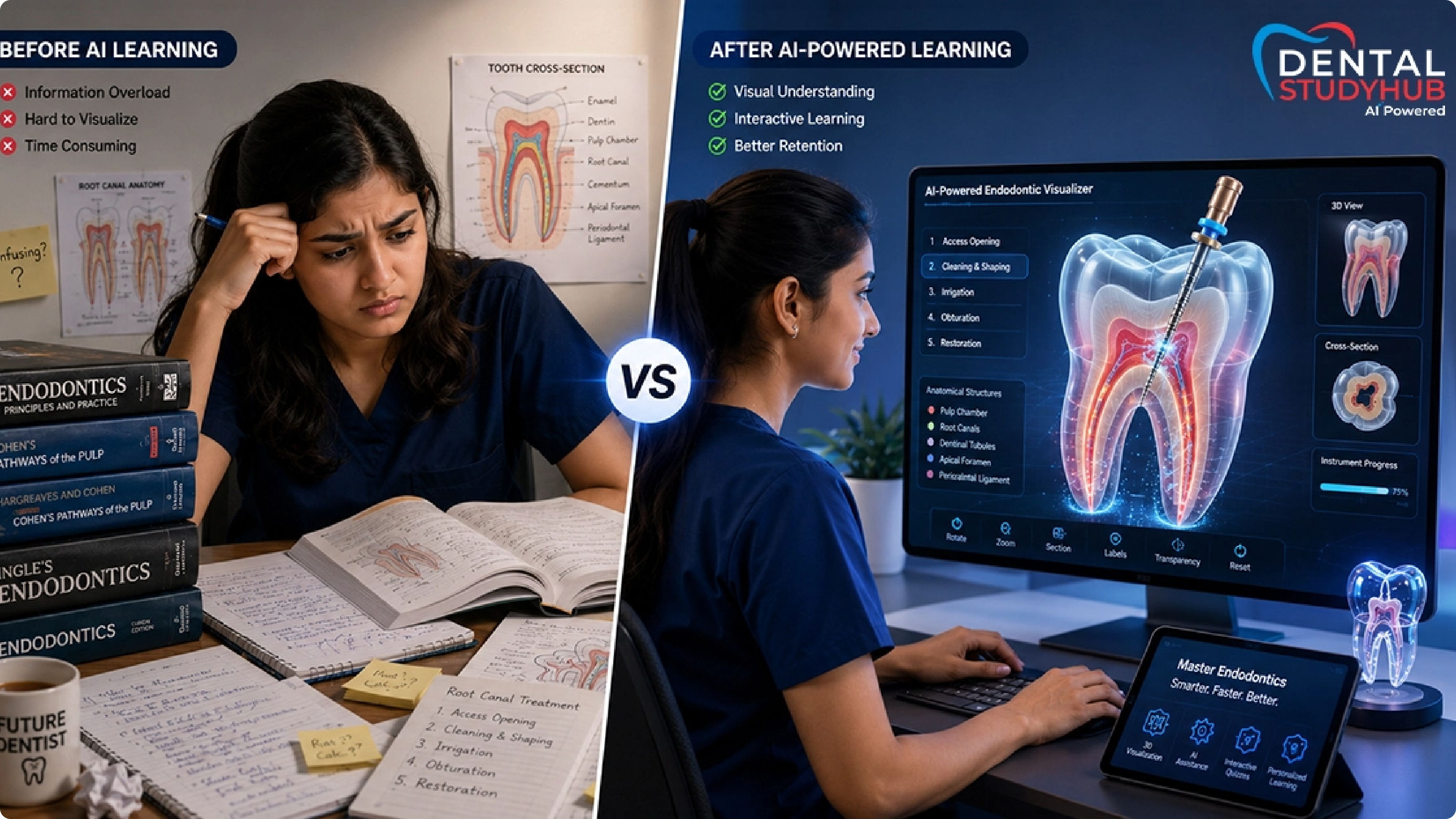
For many dental students, Endodontics is one of those subjects that seems manageable in theory but becomes surprisingly challenging when it comes to real understanding.
Most students begin by learning definitions, memorizing classifications, studying root canal treatment steps, and preparing for examinations. On paper, everything appears straightforward. But once clinical postings begin, viva questions become more application-based, and students start preparing for NEET MDS, they often realize that Endodontics demands much more than memorization.
The challenge is simple. Endodontics requires students to understand processes they cannot directly see.
What exactly happens inside a root canal? How does pulpal disease progress? Why is working length determination so important? What happens during canal shaping and cleaning? How do irrigants eliminate microorganisms? How does obturation create a seal inside the canal system?
These concepts are difficult because they require visualization.
Many students spend hours reading textbooks and reviewing notes but still struggle to build a clear mental picture of what is happening inside the tooth. This is one of the biggest gaps in traditional dental education.
The Gap Between Textbooks and Clinical Understanding

The future of dental education: AI-powered simulations transform difficult dental concepts into engaging visual learning experiences.
Most dental students learn Endodontics through textbooks, diagrams, classroom lectures, and practical demonstrations. While these methods provide essential knowledge, they often leave students trying to imagine complex biological and clinical processes on their own.
This becomes especially difficult when studying topics such as pulpal and periradicular pathology, root canal anatomy, endodontic microbiology, working length determination, obturation techniques, and endo-perio relationships.
A student may be able to reproduce information in an examination but still feel uncertain when asked to explain the process during a viva or apply the concept during clinical training.
This gap between theoretical learning and practical understanding is something many dental students experience throughout their academic journey.
As modern dentistry continues to advance, simply memorizing information is no longer enough. Students need conceptual clarity if they want to perform confidently in clinics, postgraduate entrance examinations, and future professional practice.
Why Visual Learning Works Better

Think about the difference between reading a description of a root canal procedure and actually seeing it happen.
When students can watch a process unfold visually, they understand it faster. More importantly, they remember it longer.
Most of us have experienced this ourselves. A topic that feels confusing after reading several pages of theory often becomes clear within minutes when it is explained visually.
Visual learning helps transform abstract concepts into something concrete. Instead of imagining how an instrument moves inside a canal or how bacteria affect periapical tissues, students can actually see the sequence of events.
This creates stronger understanding and better long-term retention.
That is particularly important in dental education because students are expected to recall concepts months or even years after they first learn them.
How AI Simulations Are Changing Dental Education

One of the most exciting developments in healthcare education is the use of AI-powered visual simulations.
Rather than relying solely on static images, students can now observe dynamic representations of biological and clinical processes. Complex concepts become easier to understand because learners can see exactly what is happening.
Dental Study Hub has adopted this approach to help students learn difficult subjects more effectively.
As India’s first AI-enhanced dental learning platform, Dental Study Hub combines expert-led teaching with AI-powered visual simulations designed specifically for dental education.
In the Endodontics course, complex topics such as working length determination, root canal shaping and cleaning, obturation techniques, endodontic microbiology, and endo-perio relationships are explained through realistic visual learning experiences.
Instead of asking students to imagine these processes, the course allows them to visualize them.
This approach helps build stronger concepts, improves retention, and makes learning more engaging.
For students preparing for university examinations, clinical postings, viva examinations, and NEET MDS preparation, this type of learning can make a significant difference.
Why Endodontics Is One of the Most Important Subjects in Dentistry

Root Canal Treatment remains one of the most commonly performed procedures in modern dentistry.
Patients today are increasingly focused on preserving natural teeth whenever possible. As a result, dentists with strong endodontic knowledge are often better equipped to diagnose conditions accurately, plan treatment effectively, and deliver predictable clinical outcomes.
A strong foundation in Endodontics benefits students far beyond examinations.
It contributes to clinical confidence, improves treatment planning skills, and creates a stronger foundation for advanced dental practice and postgraduate education.
For students considering specialization in Conservative Dentistry and Endodontics, early conceptual clarity can be particularly valuable.
What Students Learn in the Endodontics Course

The Endodontics course has been structured to help students build knowledge step by step, beginning with foundational concepts and progressing toward advanced clinical topics.
Students begin by understanding Pulpal and Periradicular Pathology and the biological basis of disease progression. The course then explores Diagnostic Aids that support accurate clinical decision-making.
Learners develop a detailed understanding of Endodontic Instruments before moving into Working Length Determination, one of the most critical aspects of successful root canal treatment.
The course also covers Shaping and Cleaning of Root Canal systems, Root Canal Irrigants, Sealers and Medicaments, Obturation techniques, Endodontic Microbiology, and the Endo-Perio Relationship.
Advanced topics such as Endodontic Microsurgery and Laser in Endodontics help students gain exposure to contemporary approaches used in modern practice.
By following this progression, students develop a stronger understanding of both academic concepts and clinical applications.
Who Should Take This Endodontics Course?
This course has been designed primarily for dental students who want to strengthen their understanding of Endodontics.
It is particularly beneficial for BDS students preparing for university examinations, final-year students seeking stronger conceptual clarity, interns transitioning into clinical practice, and NEET MDS aspirants looking to improve performance in one of the core dental subjects.
Fresh graduates can also benefit by revisiting fundamental concepts and strengthening areas that may not have been fully understood during undergraduate training.
More Than Just Video Lectures
Learning becomes more effective when students have multiple ways to reinforce concepts.
In addition to recorded video lectures and AI-powered visual simulations, the course includes study notes, MCQs, and assessments designed to support active learning.
The notes help students revise efficiently, MCQs provide an opportunity to test understanding, and assessments allow learners to identify areas that need additional attention.
Together, these resources create a more complete learning experience than passive video watching alone.
The Future of Dental Education Is Visual
Dental education is changing.
Students today expect more than traditional lectures and static diagrams. They want learning experiences that help them understand concepts faster, retain information longer, and apply knowledge with confidence.
AI-powered visual learning is helping bridge the gap between theory and understanding.
For many students, Endodontics becomes significantly easier once they can see what they have been trying to imagine.
That is the philosophy behind Dental Study Hub’s Endodontics course. By combining expert faculty, structured learning, study resources, assessments, and AI-powered simulations, the platform aims to help students move beyond memorization and develop genuine conceptual understanding.
The confidence gained from understanding Endodontics today can influence examination performance, clinical skills, postgraduate preparation, and future dental practice for years to come.
Explore the Endodontics course at Dental Study Hub and experience a more visual, engaging, and effective way to learn dentistry.


Comments (0)
No comments yet. Be the first to share your thoughts!