
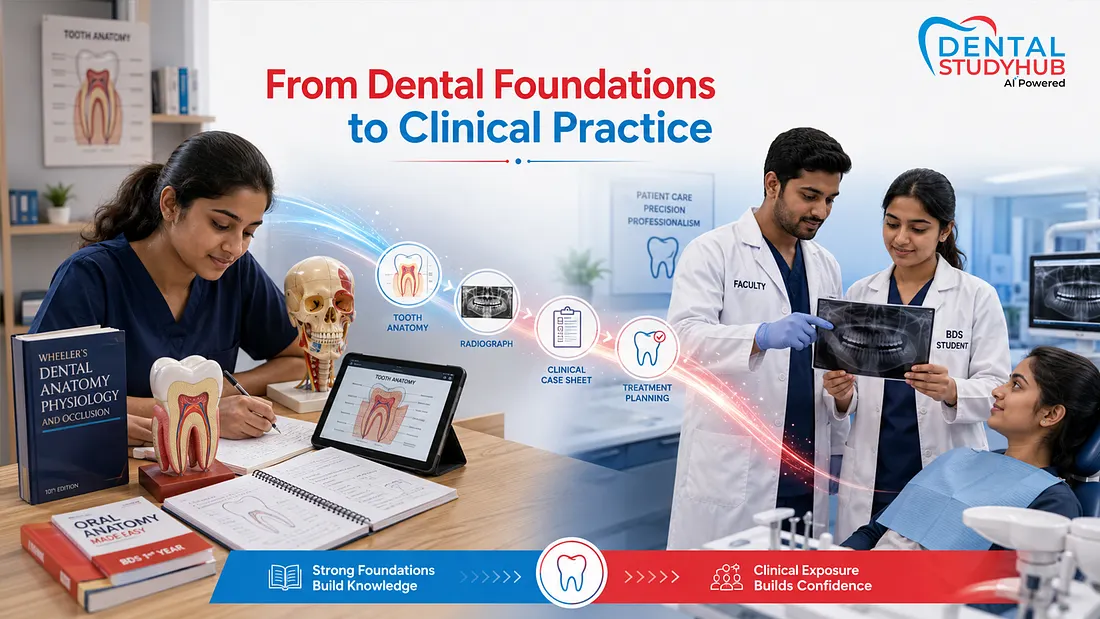
Dental school teaches subjects. Patient care demands connections. Here is how BDS students can build stronger foundations, clearer clinical reasoning and greater readiness for future practice.
Every dental student knows the moment when a familiar topic suddenly stops feeling familiar.
A patient is in the chair. The history is incomplete. The radiograph is not textbook-perfect. There is pain to assess, anxiety to manage and more than one possible explanation for what you see.
The question is no longer, “Can I remember the definition?”
It becomes, “What matters in this case — and what should I do next?”
Anatomy, pathology, pharmacology, radiology and the dental specialties are usually taught as separate subjects. Real patients do not arrive in separate subjects. Their needs require you to connect what you know, notice what you may have missed and explain your reasoning responsibly.
That is the real journey from dental foundations to clinical practice. It is also one of the hardest parts of becoming a dentist.

The Difficult Part Is Not Finding More Information
BDS students rarely struggle because there is nothing to study. The opposite is usually true.
There are lecture notes, textbooks, short videos, question banks, shared PDFs and last-minute revision materials. Yet having more content does not automatically create a clear understanding. A topic may make perfect sense the night before an examination and feel strangely distant when it appears in a viva, a case discussion or a patient encounter.
What is often missing is the bridge between subjects.
Take a patient with tooth pain. Reaching a sensible provisional diagnosis may involve pulpal and periapical pathology, root morphology, radiographic interpretation, periodontal findings, the patient’s medical history and their experience of pain. Deciding between restoration, endodontic treatment, extraction or referral adds another layer: prognosis, materials, risk, patient preference and the limits of your own competence.
Each fact may have been taught before. The challenge is bringing the right facts together at the right time.

The American Dental Education Association’s Domains of Competence reflects this wider view of dental education. Its framework connects biomedical and clinical knowledge with critical thinking, evidence-based diagnosis, treatment planning, communication, professionalism, patient-centred care and awareness of oral-systemic health.
In other words, knowing dentistry matters. Knowing how to use that knowledge matters just as much.
Strong Foundations Continue to Matter at the Chairside
Foundational subjects can feel far removed from patient care when you first encounter them. Head and neck anatomy may appear to be a map to memorise. Biochemistry can feel abstract. Pharmacology can become a long list of drugs, actions and adverse effects.
Their relevance becomes clearer later.
Anatomy helps you understand local anaesthesia, surgical access and the spread of infection. Physiology and medicine influence how you assess risk. Pharmacology affects prescribing and the management of medically complex patients. Microbiology and pathology help explain disease processes. Dental materials shape the choices you make during restorative and prosthetic care.

This is why a complete learning path should not rush students towards procedures while leaving the scientific base behind. It should keep returning to that base and show where it appears in diagnosis, treatment planning and safe decision-making.
The value is not limited to examinations. A dentist who can recognise the connection between oral findings and systemic health, explain why an investigation is needed or identify when referral is appropriate is better prepared for responsible, patient-centred practice.
From Memorising Answers to Working Through a Case
There is a noticeable change in the kind of questions students face as they move through BDS.
Early questions often ask, “What is it?” Later ones ask:
- What are the relevant findings?
- What are the possible differential diagnoses?
- Which investigation would help, and why?
- Does the medical history alter the treatment plan?
- What is the safest next step?
- Is this case within my scope, or should I seek guidance or refer?
That shift can feel uncomfortable because case-based questions rarely arrive with neat boundaries. But it is also where deeper understanding begins.

A useful study method is to take one topic and follow it beyond the textbook chapter. If you are revising local anaesthesia, for example, connect the drug with anatomy, technique, contraindications, possible complications, emergency response and patient communication. If you are studying an oral lesion, bring together pathology, medicine, radiology, history-taking and referral considerations.
This does not require abandoning conventional teaching. Evidence suggests that complementary learning formats can add value when they actively involve the student. A recent systematic review and meta-analysis of innovative learning formats in dental education reported better knowledge-acquisition outcomes than traditional instruction alone, while also noting substantial variation across studies. The sensible conclusion is not that digital learning should replace dental college. It is that well-designed, self-directed and application-oriented study can support conventional education.
Supervised patient care, hands-on training, faculty feedback and institutional assessment remain essential. An online dental course can help a student prepare and revise; it cannot independently establish clinical competence.
Exam Preparation and Practice Readiness Can Support Each Other
Students are sometimes made to feel that they must choose between studying for examinations and learning for practice. In reality, the two can reinforce each other.
For a theory paper, you need accurate concepts and an organised answer. In a viva, you need quick recall and a logical explanation. During practical or clinical assessment, you need to apply that knowledge to an image, instrument, procedure, patient or case scenario.
One useful way to revise is to move in two directions:
- Follow a topic forward: connect a foundational concept with its later diagnostic or treatment relevance.
- Look across subjects: bring together the disciplines that contribute to the same patient problem.
For example, tooth development can be linked with developmental anomalies, their appearance, diagnosis and management considerations. An oral lesion can be reviewed through oral pathology, oral medicine, radiology and general medicine rather than as four unrelated chapters.
This kind of connected revision can make BDS exam preparation more meaningful. It can also reveal knowledge gaps early — when there is still time to revisit them.
What a Complete Online Dental Course Should Offer
The length of a video library tells you very little about the quality of a learning experience. When considering an online dental course for BDS students, ask whether it helps you understand relationships, not simply whether it contains more content.
A useful programme should bring together four areas:
- Biomedical foundations: anatomy, physiology, biochemistry, microbiology, pathology and pharmacology;
- Dental foundations: oral histology, dental anatomy and dental materials;
- Diagnostic understanding: general medicine, oral pathology, oral medicine and radiology; and
- Major dental disciplines: periodontics, orthodontics, oral surgery, prosthodontics, conservative dentistry and endodontics, paediatric dentistry and public health dentistry.
Coverage alone is not enough. Students also need a clear progression, clinically relevant explanation, opportunities to revisit difficult topics and a format that can fit around lectures, clinics and university examinations.
The aim should be simple: help the learner see dentistry as one connected field.
Where Dentistry 360 Fits into This Learning Journey
For students who feel a gap between studying a subject and applying it to a case, a guided pathway can provide useful support.

Dentistry 360 by Dental Study Hub was developed for dental students and dental aspirants. The curriculum moves from biomedical and dental foundations through preclinical understanding, diagnostic subjects and the major clinical disciplines.
It is a self-paced, two-year programme with approximately 2.5 hours of recommended effort per week and 92 CPD hours, according to the course page. The course is led by Dr. Devashree Shukla, Associate Professor in the Department of Dentistry at LN Medical College & JK Hospital, Bhopal, and includes contributions from faculty and clinicians across relevant disciplines.
Its scope makes it useful for students who want one organised route through the BDS learning journey rather than a collection of disconnected resources. The course page also places emphasis on oral-systemic connections, evidence-based approaches, diagnostic thinking, treatment planning and ethical, patient-centred care.
The programme is not a substitute for BDS college, supervised clinical work or professional judgement. Its role is to complement them — to help students arrive at lectures, vivas, simulations and case discussions with a clearer mental framework.
How Connected Learning Can Influence Future Practice
No course can promise to create a successful dental practice. Patient trust and professional growth depend on many factors, including supervised experience, sound judgement, communication, ethics, consistency and lifelong learning.
But the habits developed during dental school do travel into future practice.
A student who learns to work through cases methodically may become better prepared to take a relevant history, connect oral findings with systemic health, interpret diagnostic information, discuss treatment options clearly and recognise when a case needs referral. These habits can make patient conversations more organised and case discussions more useful. They can also help a future dentist notice uncertainty instead of hiding it.
That may be one of the most valuable outcomes of connected learning: not confidence without limits, but confidence supported by reasoning — and the judgement to ask for help when needed.
A Simple Way to Study: Learn, Connect, Apply, Review
Even the best course will not help if it is only watched passively. A practical weekly routine can be built around four actions:
Learn: Understand the core idea and essential terminology.
Connect: Link it with the basic science, diagnostic subject or dental discipline that gives it context.
Apply: Use the idea in a case, image, investigation or treatment-planning question.
Review: Return to errors and write the practical takeaway in your own words.
A consistent two-to-three-hour routine can be more useful than trying to consume a large amount of content just before an examination. The goal is not to finish the highest number of videos. It is to build knowledge you can retrieve, explain and apply.
Is This Learning Path Relevant to You?
Dentistry 360 may be relevant if you are:
- a BDS student looking for organised subject revision;
- preparing for theory, viva, practical or case-based examinations;
- finding it difficult to connect basic sciences with patient scenarios;
- moving from preclinical study into supervised patient care; or
- looking for a self-paced supplement to your college curriculum.
If your BDS subjects often feel disconnected, explore how the programme brings foundational sciences, examination preparation and case-based understanding into one guided learning path.
Explore the Dentistry 360 curriculum on Dental Study Hub.
Use the programme as a supplement to your institutional curriculum, supervised clinical training and independent professional judgement.
Frequently Asked Questions
Who is Dentistry 360 designed for?
Dentistry 360 is designed for dental students and dental aspirants seeking an organised learning path across foundational, preclinical and clinical subjects.
Can an online dental course replace BDS college or clinical training?
No. An online programme can support study, revision and conceptual understanding, but it cannot replace a recognised dental qualification, institutional teaching, supervised patient care or hands-on clinical training.
Can Dentistry 360 support BDS exam preparation?
The curriculum covers foundational and major dental subjects relevant to theory, viva, practical and case-based learning. Individual outcomes depend on the learner’s prior knowledge, consistency, revision and application.
How much time does the programme require?
The course page recommends approximately 2.5 hours of effort per week. As the programme is self-paced, students can plan their study around lectures, clinics and examinations.


Comments (0)
No comments yet. Be the first to share your thoughts!